Saturday, June 13, 2015

WF#19 How Whales Feed: Part Two: Baleen Whales - Lunge Feeding

Rorquals, (superfamily Balaenopteraidea), including blues, humpbacks, fins, and minke whales, all feed using a technique called lunge feeding. They approach their prey, most often from below, then with a sudden burst of great speed, they lunge at their prey with their mouth open and engulf it. Humpbacks actually have an additional technique they use to improve upon this called "bubble net lunge feeding"... to be continued...


Photo credit: The Guardian

Whales normally approach their prey from below so that they can trap it at the surface, like this one has done. This humpback's mouth is full of of prey and water - you can see his stretchy throat grooves are fully extended to allow him to hold in as much as possible (I'll do a post on those fascinating throat grooves later - there's a lot of interesting science going on there!). What he would do next in this picture is close his mouth, lock his jaws and move his tongue up to force the water through his baleen plates and out of his mouth, leaving only the prey inside for him to eat. Success!

Friday, June 12, 2015

WF#18 How Whales Feed: Part One: Baleen Whales - Filter Feeding

Baleen whales (order mysticeti) have baleen in place of teeth, and so they feed by the filter-feeding method instead.
Photocredit: Wikipedia
Baleen, which looks like a giant comb, is used to filter food out of mouthfuls of prey-rich water


Photo credit: Smithsonian Museum of Natural History

Wednesday, February 4, 2015

WF#17: Hair for Teeth?!?!?!?! (Whales Vs Dolphins part 4, kind of...)

Pretty straight-forward. Toothed whales have teeth,
baleen whale have baleen (duh). Marine biologists don't mess around. Of course there are scientific names - toothed whales = odontoceti and baleen whales = mysticeti. Remember that from the Whales Vs Dolphins series?


More on baleen and baleen whales later...

Saturday, January 24, 2015

WF#16: Migaloo The White Whale

"Migaloo is the world's only Albino Whale! He is a humpback and frequents Australian waters. There are other white whales (presumed by some to be his children) who have patches of pigmentation where he has non, making Migaloo the only true albino." The other white whales - three humpbacks known as Willow, Bahloo, and a calf called Migaloo Jr, all have small patches of pigmentation, most likely due to leucism. It is unknown if any of these whales are actually related or not.

There is one possible exception to this statement. A white orca has been spotted near Russia. However, scientists have been unable to verify if the orca, Angel, is a true albino like Migaloo, as all sightings have been fleeting.


Migaloo is probably one of the most famous whales in the world. There are whole websites dedicated to him, tons of articles about him, and you can even adopt him from the Pacific Whale Foundation!

Thursday, January 8, 2015

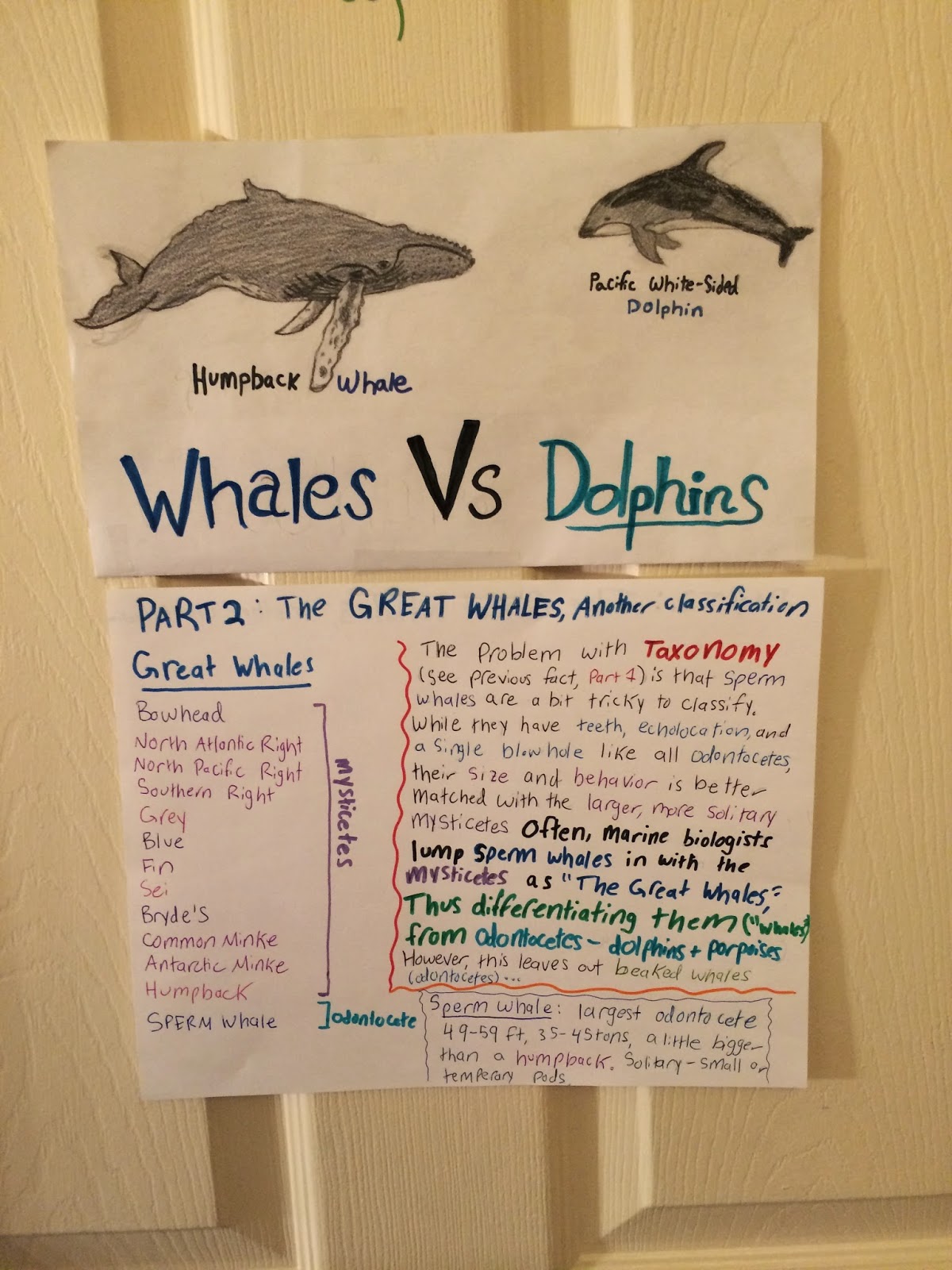
WF#14: Whales Vs Dolphins Part 2: The Great Whales, Another Classification

Alright whale fact minions... hmm that's not much better than groupies is it?

Here's Whales Vs Dolphins Part 2: The Great Whales.

This is where most of the confusion comes from. No one doubts that a sperm whale (leviathan of Moby Dick) is a whale, but there is some confusion about what a dolphin is, even though they are both in the same suborder (Odontoceti).  Separating out the "great whales" leads a new and more narrow meaning of the word "whale," which differentiates them from dolphins and porpoises.

The problem is that with this distinction in place, what are beaked whales? They're not among the great whales (so not a "whale") but not dolphins or porpoises either, yet they are still odontocetes. This goes to show that every form of classification has it's flaws.

Look out for Part 3: Evolution tomorrow!

WF#13: Whales Vs Dolphins Part 1: Taxonomy

 Ok whale fact groupies... Can I call you that? Probably not...

Anyway this is a confusing one. Whales Vs Dolphins? This is where science gets hard. Everyone says something different. Here's how I see it...

But there are many different sides to consider, so this will be in a few different parts. Here's Part 1: Taxonomy. I'll post Part 2 soon, which is loosely going to be "How Marine Biologists Talk." I know, catchy right? Not really it's horrible.


Sorry for the rambling. Enjoy and I'll catch you later.

[p.s. Yes, I drew that. It took all day. It took even longer to write out the classifications legibly. And for those of you who've asked, yes, these facts all come from the top of my head, but then I always fact check them, mostly for spelling.]