Showing posts with label Whale Facts. Show all posts

Sunday, September 3, 2017

WF#24: A World of Sound

In the ocean, many organisms depend on sound to navigate the world around them. This is very much true for whales.

Whales use sound to communicate. For most baleen whales, song is an essential component of courtship. For the echolocating toothed whales, sound is literally how they perceive the world around them.

Clearly, sound is very important to cetaceans... And it is very important to those of us studying them!

Whale biologists use sound to study whale populations.

How? See whale fact 25 to learn more!


Humpback whales assume this position when they sing. Only the males sing - it is believed that song is sexually selected, either for attracting females, or warning off other males.
Aside from song, whales of all species and sexes vocalize to communicate. the difference is that the songs are specific, stereotyped and repeated, while vocalizations are more random.
Photo credit: indopacificimages.com
Echolocation is like sonar - toothed whales create high-frequency clicks and based on the echos that bounce back, they can determine size, shape, distance and even angular direction! All toothed whales echolocate, but they also vocalize to communicate. Vocalizations have a wider range of patterns, pitches, and duration.
Photo credit: dolphincommunicationproject.org

Thursday, March 2, 2017

WF#23: The Return: Omura's Whales


The world's newest baleen whale, Omura's Whale (Balaenoptera omurai) was only just recognized as a distinct species in 2003! Prior to their discovery, they were often confused with Bryde's Whale. It was only recently that we had our first ever siting of a live Omura's Whale off the coast of Madagascar! There is still so much yet to be discovered! Currently, marine biologists are using passive acoustic data to identify and better understand these exciting new members of the mysticeti order!


Omura's Whale


VERSUS


Bryde's Whale
source: WDC


It is easy to see how Omura's whales were confused for Bryde's whales for so long! The main differences are that Omura's whales have a unique asymmetrical pigmentation pattern, where one side of the jaw is significantly lighter than the other. Another distinction is that they have nearly twice as many throat grooves that Brydes whales have.

For more information on Omura's whales, see The Omura's Whale Project, the team that are pioneering these efforts!


Saturday, January 23, 2016

WF#22: How Whales Feed Part Five: Baleen Whales - Gray Whale Bottom Feeding


 Gray whales have baleen, but they prey on the critters on the ocean floor. So, they swim sideways along the bottom, sucking up the sediments and filtering out the goodies, like a giant vacuum cleaner. This form of filter feeding is called bottom feeding.

 Fun Fact: Grey Whales are either righties or lefties when it comes to which side of the face is scraping along the bottom - it's always the same side! As a result, many have barnacles and other growths only on one side of their face, as they all get knocked off during feeding on their chosen side.


Photo Credit: UC Berkley

You can see a Gray whale bottom feeding in this picture. Notice that it is sideways. It most likely always feeds in this orientation.
Photo credit: Scienceline.org


Here you can see how there are more barnacles on one side than the other!


WF#21: How Whales Feed Part Four: Baleen Whales - Humpback Whale Lobtail Bubble Net Feeding

A population of humpback whales have modified bubble net feeding (using bubble to catch prey) to add lob tailing - slapping the water with the tail. This scares the prey away from the surface thus reducing loss stealing sea birds. It also adds to the bubble net effect in creating a tight bait ball.


This technique, first observed near Baja Mexico, has spread from population to population, proving that humpbacks learn from and teach each other and that they have a culture!


Photo credit: offset.com


The picture here shows a humpback whale lob-tailing. in this case, it's entire lower third of it's body (aka peduncle) is out of the water, so this can also be termed as a peduncle throw.

Sunday, July 26, 2015

WF#20: How Whales Feed Part Three: Baleen Whales - Humpbacks' Bubble Net Feeding

Humpback whales have a genius technique that is a spin off of lunge feeding which is completely unique to them: Bubble Net Feeding. It can be done cooperatively in groups or individually. The whale(s) circle beneath their prey. While doing so, they blow bubbles from their blowholes and mouths. Sometimes they also sing - this is more often done when in a group setting than when alone, but has been observed both ways. The bubbles and noises frighten and confuse the prey and they instinctively draw closer together into perfect bite-sized bait balls. The whale(s) then lunge feed with ease!

A humpback whale bubble net feeding
photo credit: Wikipedia
The same technique can also less commonly be called a 'bubble cloud.' The cloud is used less for the herding the prey into a tight ball than for simply blinding the prey from the view of the lunging whale until it is too late. It is hard to say if these two techniques are actually distinctly different or one in the same. There are certainly variations a lot on the bubble netting technique, however, which actually hold strong significance for this species... more about that next time...

Saturday, June 13, 2015

WF#19 How Whales Feed: Part Two: Baleen Whales - Lunge Feeding

Rorquals, (superfamily Balaenopteraidea), including blues, humpbacks, fins, and minke whales, all feed using a technique called lunge feeding. They approach their prey, most often from below, then with a sudden burst of great speed, they lunge at their prey with their mouth open and engulf it. Humpbacks actually have an additional technique they use to improve upon this called "bubble net lunge feeding"... to be continued...


Photo credit: The Guardian

Whales normally approach their prey from below so that they can trap it at the surface, like this one has done. This humpback's mouth is full of of prey and water - you can see his stretchy throat grooves are fully extended to allow him to hold in as much as possible (I'll do a post on those fascinating throat grooves later - there's a lot of interesting science going on there!). What he would do next in this picture is close his mouth, lock his jaws and move his tongue up to force the water through his baleen plates and out of his mouth, leaving only the prey inside for him to eat. Success!

Friday, June 12, 2015

WF#18 How Whales Feed: Part One: Baleen Whales - Filter Feeding

Baleen whales (order mysticeti) have baleen in place of teeth, and so they feed by the filter-feeding method instead.
Photocredit: Wikipedia
Baleen, which looks like a giant comb, is used to filter food out of mouthfuls of prey-rich water


Photo credit: Smithsonian Museum of Natural History

Wednesday, February 4, 2015

WF#17: Hair for Teeth?!?!?!?! (Whales Vs Dolphins part 4, kind of...)

Pretty straight-forward. Toothed whales have teeth,
baleen whale have baleen (duh). Marine biologists don't mess around. Of course there are scientific names - toothed whales = odontoceti and baleen whales = mysticeti. Remember that from the Whales Vs Dolphins series?


More on baleen and baleen whales later...

Saturday, January 24, 2015

WF#16: Migaloo The White Whale

"Migaloo is the world's only Albino Whale! He is a humpback and frequents Australian waters. There are other white whales (presumed by some to be his children) who have patches of pigmentation where he has non, making Migaloo the only true albino." The other white whales - three humpbacks known as Willow, Bahloo, and a calf called Migaloo Jr, all have small patches of pigmentation, most likely due to leucism. It is unknown if any of these whales are actually related or not.

There is one possible exception to this statement. A white orca has been spotted near Russia. However, scientists have been unable to verify if the orca, Angel, is a true albino like Migaloo, as all sightings have been fleeting.


Migaloo is probably one of the most famous whales in the world. There are whole websites dedicated to him, tons of articles about him, and you can even adopt him from the Pacific Whale Foundation!

Thursday, January 8, 2015

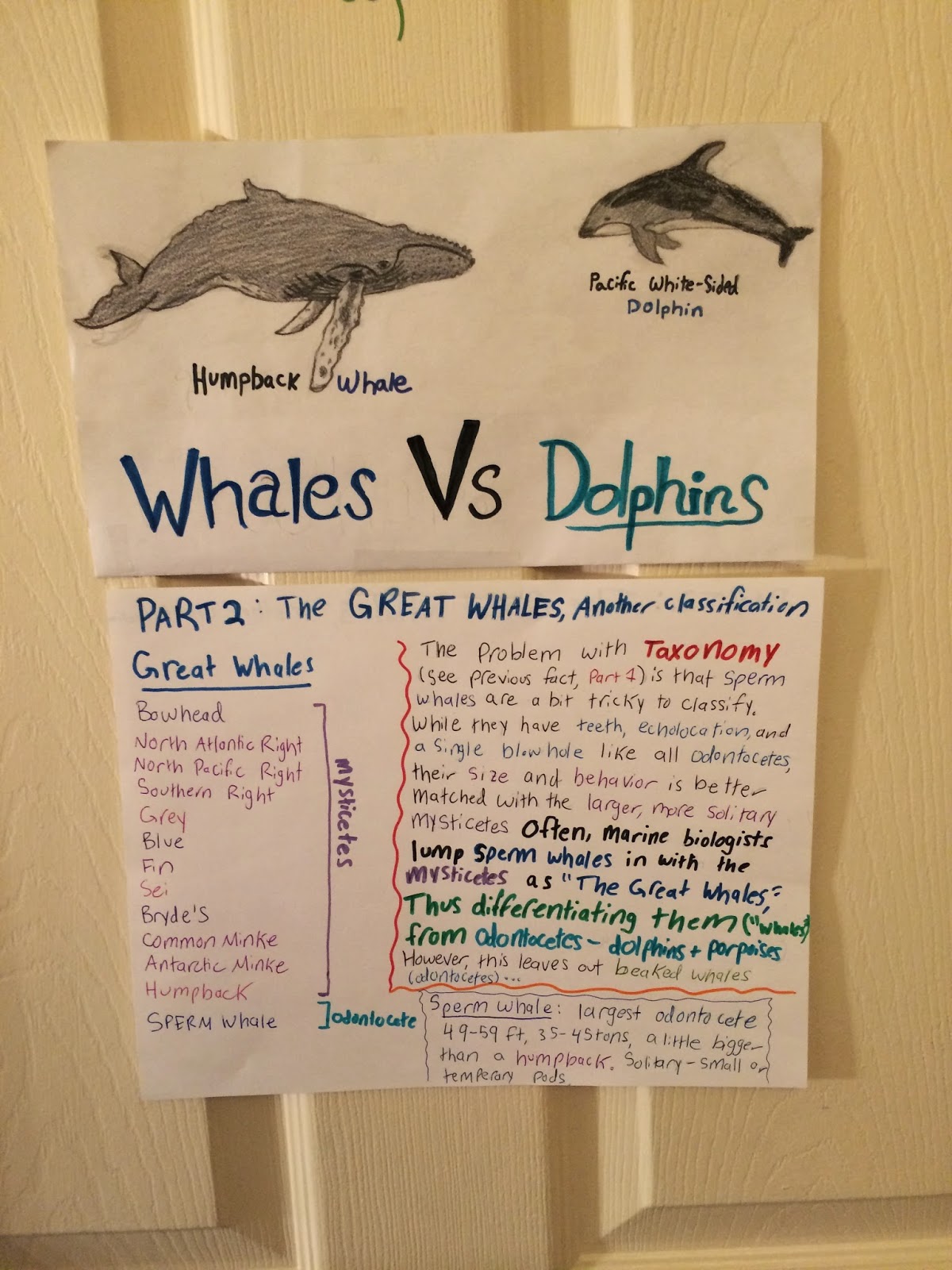
WF#14: Whales Vs Dolphins Part 2: The Great Whales, Another Classification

Alright whale fact minions... hmm that's not much better than groupies is it?

Here's Whales Vs Dolphins Part 2: The Great Whales.

This is where most of the confusion comes from. No one doubts that a sperm whale (leviathan of Moby Dick) is a whale, but there is some confusion about what a dolphin is, even though they are both in the same suborder (Odontoceti).  Separating out the "great whales" leads a new and more narrow meaning of the word "whale," which differentiates them from dolphins and porpoises.

The problem is that with this distinction in place, what are beaked whales? They're not among the great whales (so not a "whale") but not dolphins or porpoises either, yet they are still odontocetes. This goes to show that every form of classification has it's flaws.

Look out for Part 3: Evolution tomorrow!

WF#13: Whales Vs Dolphins Part 1: Taxonomy

 Ok whale fact groupies... Can I call you that? Probably not...

Anyway this is a confusing one. Whales Vs Dolphins? This is where science gets hard. Everyone says something different. Here's how I see it...

But there are many different sides to consider, so this will be in a few different parts. Here's Part 1: Taxonomy. I'll post Part 2 soon, which is loosely going to be "How Marine Biologists Talk." I know, catchy right? Not really it's horrible.


Sorry for the rambling. Enjoy and I'll catch you later.

[p.s. Yes, I drew that. It took all day. It took even longer to write out the classifications legibly. And for those of you who've asked, yes, these facts all come from the top of my head, but then I always fact check them, mostly for spelling.]

WF#12: Funky Dolphins...


WF#11: Whales Change the Climate

Check out the awesome video by Sustainable Human:

 How Whales Change the Climate

WF#10: The Power of Poop


WF#9: The True Top Predators of the Ocean

Aside from humans, of course.

WF#8: 3 Orca Populations


WF#7: Evolution


WF#6: Whales are the true JAWS!

An attempt at a Halloween-themed whale fact.

Rorquals (whales in the family Balaenopteridae, including humpbacks and blues) can unhinge their jaws and have 12-15 expandable throat grooves. In one lunge, they can take in 100 tonnes of krill-filled water in 10 seconds!

Check out this video of a lunge feeding humpback that almost swallows the cameraman!
Diver Nearly Swallowed by Whale

WF#5: Humpback Whale Scientific Name Part 3

The second half of the humpback whale's scientific name is "Novaeangliae" which means "New Englander."

This is because humpbacks were first sighted and scientifically described off the coast of New England.